Wednesday, December 15, 2010

Hybrid Car - Parallel Hybrid or Series Hybrid

All hybrids have in common is the ability to generate electric current, store it in a large battery, and use that current to help drive the car. Hybrids capture electrical energy produced by a regenerative braking system, and their engines can power a generator, too.

A series hybrid is very similar to a parallel hybrid. Both have the advantage of increasing fuel efficiency compared with conventional gasoline-powered vehicles, and giving the driver greater range than an all-electric vehicle. Both types of hybrids are reliant on large battery packs to store energy and both types may use additional technologies like regenerative braking to capture energy that would otherwise go to waste.

However, the mechanisms are quite different:

Parallel Hybrid

With a parallel hybrid electric vehicle, both the engine and the electric motor generate the power that drives the wheels. The addition of computer controls and and a transmission allow these components to work together. Parallel hybrids can use a smaller battery pack and therefore rely mainly on regenerative braking to keep it recharged. However, when power demands are low, parallel hybrids also utilize the drive motor as a generator for supplemental recharging, much like an alternator in conventional cars.
Series Hybrid
This is the simplest hybrid configuration. In a series hybrid, the electric motor is is the only means of providing power to get your wheels turning. The motor receives electric power from either the battery pack or from a generator run by a gasoline engine. A computer determines how much of the power comes from the battery or the engine/generator set. Both the engine/generator and regenerative braking recharge the battery pack. The engine is typically smaller in a series drivetrain because it only has to meet average driving power demands; the battery pack is generally more powerful than the one in parallel hybrids in order to provide remaining peak driving power needs. This larger battery and motor, along with the generator, add to the cost, making series hybrids more expensive than parallel hybrids.

Comparison:
  • The series hybrid can be charged off of the power grid, for convenience & much cheaper operation (< 20% of the cost of running on gas) with no loss of performance (except range), otherwise use the onboard generator, The parallel hybrid may be able to run off the power grid if you expand the battery pack, but with reduced performance.

  • The series hybrid is much simpler in design & maintenance than the parallel hybrid. It does not need a clutch or transmission, no oil changes, spark plugs, fuel/oil filters except on the separate generator which can be removed or replaced easily. It does not need the complex control / interface between the gas engine & electric motor.

  • The series hybrid has better acceleration due to the superiority of the much larger electric motor to the gas motor in this respect.

  • The generator engine on the series hybrid can be much smaller, simpler and more efficient than on the parallel hybrid.

Monday, December 13, 2010

Hybrid Car - Basic knowledge

Depleting fuel resources and awareness about the environment issues in the late 1990s caused automobile manufacturers started to explore alternative forms of transportation, including vehicles powered by hybrid motor. Neither technology is particularly novel, yet it has a place in the future of transportation.

A hybrid car is a car that uses two or more distinct power sources to move the car. The term most commonly refers to hybrid electric vehicles (HEVs). It combine an internal combustion engines (generally gasoline or Diesel engines, powered by a variety of fuels) and electric batteries to power electric motors.

A hybrid electric vehicle produces far less toxic emissions then standard gasoline only vehicles. The Toyota Prius, for example, has 90% less emissions then a comparably sized conventional car. The use of the electric motor for propulsion in low speed environments and the technology that allows a HEV to turn off the combustion engine when idling greatly reduces the emissions from the vehicle. Hybrid electric vehicles use smaller engines than conventional automobiles and have less moving parts that are prone to wearing out and creating waste. The most attractive environmental advantage to an HEV is the increased fuel efficiency of these types of vehicles. For most consumers, this is the most important advantage of all during times of high fuel prices and the environmental benefit of the vehicle consuming less fossil fuel often goes unrecognized.


Engine: More efficient than traditional engine found in most cars
Electric motor: Uses magnets to produce output
Battery: Charged by engine via generator when cruising, or electric motor when braking
Power split device: Allows engine and motor to be used independently, or together
Braking system: Energy from braking recharges battery, by using motor as generator
Inverter: Converts DC power from battery to AC power for motor

Toyota was the first to make a broadly accepted hybrid vehicle with the Toyota Prius in 1998. By early 2010, the Prius global cumulative sales were estimated at 1.6 million units. The 2010 Prius has an estimated U.S. Environmental Protection Agency combined fuel economy cycle of 50 miles per US gallon (4.7 L/100 km).

Friday, December 10, 2010

KLIMS 2010 Proton Saga EV

Recently we have been talking about GREEN technology. GREEN tech is  important to conserve the natural environment and resources, and to curb the negative impacts of human involvement. So, minimising the impact cars have on environment is a top priority. The Automobile industries sectors is now doing their part in mitigating the effects of environmental threat to mankind by developing HYBRID car or Ev. It is not only to reduce emissions from the vehicles, but to make the entire life-cycle of a car more environmentally friendly to maintain a sustainable environment for future generation.


As the leader of local automobiles industry, Proton through its Engineering Division has initiated the electric vehicle (EV) project in November 2008 when a team of technologist was dispatched to Lotus Engineering UK to develop two units of electric vehicles.

In conjunction with KLIMS 2010, Proton has revealed its first generation of concept Electric Vehicle (Ev) name Proton Saga Ev concept. Sage Ev concept can be viewed as Proton’s long term strategy of acquiring and commercializing the technology as indicated in Proton’s Technology Roadmap. This is also part of the initiative to support the National Green Technology Policy that was implemented by the goverment to chart the nation’s development in green technology as the new driver of economic growth.


The primary difference between a HYBRID car and an electric car (Ev) is that the hybrid car derives some of its power from a conventional gasoline engine. On the other hand, a true electric car gets all of its power from electrical sources, and thereby is a completely non-polluting zero-emission vehicle (ZEV).


EV Saga Specification:

Engine:
Azure Dynamics AC24LS 5.5 kW 4-pole, three-phase air-cooled AC electric motor (and corresponding DMOC445 digital motor controller) that can spin up to a maximum of 11,000 rpm, and which offers 47 kW (63 hp) of peak power and 92 Nm of max torque, working with a single-gear transmission and a 15 kWh, 50Ah lithium-ion battery.

Battery:
The battery consists of 8 separate modules, and each module is made up of 40 cells weighs in at 240 kg. It doesn’t completely eat up the boot space of the car however it is just 150 kg more than a standard Saga, with the battery being the hefty lad. Off a normal 240V point, the battery takes seven to eight hours to charge fully, though it can be fast charged if the need arises.

Performance
The EV Saga has a top speed of 125 kph and offers a 160 km range (in NEDC cycle mode), with a 0-100 kph time of 14.5 seconds.

Wednesday, December 8, 2010

KLIMS 2010 Perodua Bezza

Perodua has unveiled its next-generation prototype model, Perodua Bezza during the KLIMS 2010, held at PWTC, 3rd-12th December.


The stunning new look and sleek concept is tagged as the sort of vehicle that’s ideal for the future Gen-Y crowd looking for something bigger to efficiently traverse the concrete jungle as well as for longer journeys.


Perodua Bezza was desinged by 53 Malaysia designers, and led by P2′s chief designer Muhammad Zamren Musa. The five-seater concept, which uncannily contains traces of the Prius in its exterior lines, features sliding rear doors and swivel front seats for easy ingress and egress, along with a distinctly agressive headlamp design.


The clean-looking interior features a cockpit layout dashboard, with the instrument panel designed for the driver’s visual ease, and the floating centre console is shaped to provide additional legroom for both driver and front passenger, with a large luggage storage area part of the design brief as well.


source: paultan.org

Monday, December 6, 2010

KLIMS 2010

Kuala Lumpur International Motor Show 2010 will be exhibiting at Putra World Trade Centre in Kuala Lumpur from 3 December to 12 December 2010 by Malaysian Automotive Association (MAA).
In this motor show, you will be expecting to see the latest automotive technology including the newest models and a selection of concept and revolutionary vehicles from all around the world. The Batmobile and a 16-foot high Bumblebee from The Transformers movies will be among the attractions at the Kuala Lumpur International Motor Show 2010 (KLIMS) too.

Below is the detail info of KLIMS 2010
Date : 3 – 12 December 2010
Time : Weekdays 11.00am – 10.00pm | Weekends 10.00am – 10.00pm
Venue : Putra World Trade Center (PWTC)


View Putra World Trade Centre in a larger map

Ticketing info:

Adults – RM15.00 Weekdays | RM20.00 Weekends & Public Holiday

Child (aged 12 & below) – RM5.00 Weekdays | RM5.00 Weekends & Public Holiday

Family Package – RM30.00 Weekdays | RM40 Weekends & Public Holiday
FREE for children aged 12 & below (max. 5 children)

Student – RM5.00 (with student ID card / school uniform) Weekdays | RM20.00 Weekends & Public Holiday

Handicapped – Complimentary Entry (with handicapped card / physically handicapped) FREE for accompanying person, 1 ticket only

Friday, December 3, 2010

DIY car repair - Clean your car battery

Your car's battery is the starting point for every system it uses. So you should never let anything come between your car and a good battery connection.

In fact, you can notice that there are certain signs or symptoms when your vehicle battery is becoming weak:
1.Head lights become dimmer or less bright.
2.The horn becomes less audible.
3.Ignition becomes more difficult and the engine takes a longer time to start.
4.There will also be some problems with your automatic door systems.

Most common problems with car battery is corrosion. Car battery is powered by lead-acid battery, so it is best for nasty corrosion to happened, which will appear as white, crusty residue around the battery posts.


However, you can clean it by yourself, but you need to be extremely careful about this.

The first step is to remove your battery terminals. You can use open end wrenches or something more universal like or a small Crescent wrench.  
You should always remove the negative cable first (black colour). Place one wrench on the outside nut and (if needed) the other wrench on the other side.
You can use a piece of tape to hold this lead away from the battery while working on the positive side, so that it doesn't touch the negative terminal again.


There are a number of ways to get the corrosion off your battery posts.The most easiest way is to mix the baking soda powder with some water to neutralize the acid that accumulate at battery terminals.

Squirt the solution on the battery posts and terminals, then brush it to remove the stain.


If you have a serious case of corrosion like the one in pictures above, you may want to remove the battery, and clean it up to prevent all that corrosion from getting around in the engine compartment.

You'll need a wire brush and a little elbow grease to liberally brush all of the parts, especially the inside of the terminals, until the corrosion is gone


Once they're clean, install anti-corrosion discs if you're using them. Remember to install the red disc on the positive post and the green on the negative.

Last step is to reconnect the battery. First attach the positive terminal clamp, and then attach the negative. Then, you are set to go.

Thursday, December 2, 2010

DIY car repair - Replace Air Filter

Car engine is like a giant pump, it suck in air, mixes the air with fuel and ignites this mixture in order to produce the power to move your car. 


Over time the air filter can become clogged with dirt, grime, bugs and debris, it will greatly affected the efficiency of your car engine. Besides that, the faulty air filter may causes dirts to enter engine block, causing damage to car engine in long term.

it is important that you check the filter and change it once a year or every 25000km, .If you live in an averagely dusty area, it is recommended to perform regular checking once in a while and replace it as soon as it needs would be much better.


How to replace air filter


First locate the air box or canister that houses the air filter. Follow the tube or snorkel away from the engine until it ends at the air box.


Release any clips or fasteners that hold the air box together.


Loosening hose clamps can help in separating the air box.


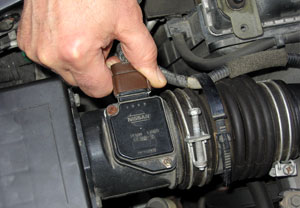
Be careful not to damage the MAF/MAP sensor or wiring. Disconnect if additional slack is needed.


Separate the air box and remove the old air filter. While wrestling with the clips and tubes, be careful not to tear any hoses or damage sensors.


This air filter had done its job well.


Use a shop vacuum to remove any remaining debris from the air box.


Install the new filter, making sure it seats in the air box housing.


Reinstall any clips or fasteners. Reconnect and retighten anything loosened during disassembly. Check to see if the air box parts form a tight seal. 


For more information: automedia

Wednesday, December 1, 2010

DIY car repair - Radiator Fluid (coolant) Inspection

A coolant is a fluid which flows through your car radiator to prevent its overheating. The most common coolant is water. There are several types of coolant you can find in market, each of them provided the same function.

Proton Genuine Coolant

Coolant is better and faster heat absorber compared to water, but it is corrosive to the radiator. In order to minimize the corrosive effect, it is important that you use a combination of water and coolant to protect your car radiator. The mixture ratio is stated in the instruction (normally is 50:50). You are advised to use only distilled water, due to the chlorine and particles present in the tap water which may block your tiny water gallery OR cause rust.
Radiator corrosion causes by coolant

The coolant in your radiator doesn't last forever. It is crucial you perform a coolant checking once every 2 to 3 days, fill it up when need. Coolant level should be between "low"and "full" marks and not to approach to any of them. Apart from that, from time to time it can break down and start to corrode the inside of your radiator. This can lead to cooling problems and radiator repair. A radiator flush once a year is cheap insurance against radiator repairs.

Refill your coolant


Important tips:
  • If u need to frequent fill up your radiator, your car radiator may have leaking problem. You need to carefully investigate coolant hoses regarding leaks, tears or damage.
  • In most cases the liquids are brightly colored - green, red, yellow, blue - and usually thin and transparent. The coolant must be clean and contain no debris. If you see something else in the coolat container, oil for example, this means that you may have an engine defect somewhere.You’ll probably need that will need a professional help. 
  • Brown color of your coolant shows that your car needs a radiator flush.

Tuesday, November 30, 2010

DIY car repair - Regular maintenance

Regular maintenance are important to keep your car out of the repair shop. Regular checking a few of these little things will help to ease the pain in your wallet. It may seem like a waste of time to constantly perform maintenance tasks on your car, but most of the regular maintenance checks only take a minute,so don't be lazy. It helps to save your money too. So, few minutes a day is worth the effort.


If you keep a regular maintenance schedule and checklist you'll always stay on track and avoid costly repairs. Maintenance intervals are a good way to keep on top of things. Below is a sample of Car Regular Maintenance Checklist:
  • Radiator Fluid (coolen) Inspection 
  • Air Filter Inspection 
  • Tire checks
  • Windshield Wipers checks
  • Brakes Inspection
  • Car Battery checks
  • Headlights Inspection (especially on rainy season)
  • Fuel Filters Inspection
  • Timing Belt Inspection
  • Power Steering Fluid Inspection
  • Spark plugs Inspection
  • Oil change

Monday, November 29, 2010

DIY car repair - What tools you need

Car repairing is something many of us say we do, but in reality few of us take the time to properly maintain our vehicles. we tend to let the professional to handle it, whenever there is a problem. Truth be told, there are even some repairs that could be classified as maintenance, just because the repair itself functions to keep a larger disaster from happening.

In this series of articles, we are going to discuss about how to "Do-It-Yourself in car repair". To jump-start our journey into the world of DIY car repair, be sure our tool box has what we need to make the repair easy, pain free, and safe. We can easily get all these important tools from Ace Hardware, hardware shops or any hypermarkets.

Basic tools we need are:
  • screwdrivers (all size)
  • hex keys
  • open end wrenches
  • oil filter wrench
  • ratchet driver in 1/4 and 3/8, maybe 1/2
  • cutting pliers
  • extensions
  • sockets
  • torque wrench
  • PB Blaster or another penetrating oil
  • work light, fluorescent or LED
  • repair manual
  • pliers (sometimes it has to be)
  • channel locks
  • crescent wrench
  • breaker bar or impact gun